
Shares of state-owned bank stocks were under pressure on Monday due to muted deposit and credit growth numbers reported by these lenders in the October-December quarter (Q3) of 2024-25 (FY25). The Nifty PSU Bank index was down 4 per cent, with Union Bank of India emerging as the biggest loser as its shares fell 7.5 per cent to close at Rs 114.7, followed by a 5.7 per cent drop in shares of Bank of Baroda (BoB) to Rs 228 and a 4.7 per cent slide in shares of Bank of India to Rs 99.8 on the National Stock Exchange.

If there is no third wave of the pandemic, the fiscal position of the Centre and the states will be much better than budgeted for FY22 and the states may garner Rs 60,000 crore more in tax collections at Rs 8.27 lakh crore this fiscal year than they have budgeted, a report said. The report by SBI Research on Monday bases its optimism on GST collection so far this fiscal, which has been the best ever in spite of the fact that the two months bore the maximum brunt of the second wave -- with April setting a record Rs 1.41 lakh crore and May collection a tad low at Rs 1.03 lakh crore. The report also said overall government finances do not look overstretched as GST collections have continued to maintain pace so far and the additional fiscal impact arising from free vaccination and more food supplies will only be around Rs 28,512 crore.

Official data released on Friday said the GDP is estimated to have grown by 5.7 per cent for the April-June period, as against a 4.6 per cent growth notched for the same period year ago.

SBI was the top loser in the Sensex pack, shedding around 3 per cent, followed by Bajaj Finserv, Tech Mahindra, Sun Pharma, Bajaj Finance and Axis Bank. Nifty fell 143.60 points to 17,873.60.

The Rs 6,145-crore initial public offer of electric two-wheeler company Ola Electric Mobility got fully subscribed on the second day of bidding on Monday, driven by demand from retail investors and non-institutional investors. The initial share sale received bids for 49,43,63,610 shares against 46,51,59,451 shares on offer, translating into 1.06 times subscription, according to the NSE data.

These 10 stocks represent the best mix of value and growth, offering relatively low price-to-earnings and price-to-book ratios, a high return on equity, and sufficiently high potential from current levels.

Ensure the sum insured for the super topup is enough to cover even worst-case scenarios.

Quant funds are a unique offering in the MF space as the investment decisions are driven by a blend of active and passive strategies.

Indicating a faster-than-expected recovery, remittances from migrant labourers and the number of first-time EPFO registrations have crossed the pre-lockdown levels in September, according to a report. Another silver lining is the massive 60 per cent increase in the number of Jan Dhan accounts to over 41 crore and the balances in them, which also indicate the fall in crimes during the lockdown months, SBI Research said in a report on Tuesday. After a significant reduction in remittances due to the lockdown in April, it improved in June and July, and the numbers in September have crossed the pre-pandemic level in February.

Following the demonetisation move, the recast in direct tax moves is expected to give a boost the economy.

The outflows could be a result of a mix of factors led by the underperformance of some of the larger funds amid elevated return expectations.

In 5 years, the AMC has clocked a growth rate of 40% with its AUM up nearly 4 times.

Largecap, flexicap, and balanced advantage funds together recorded a net inflow of Rs 9,363 crore in August, representing a 70% increase from the previous month's total.

The report said the moratorium for three more months will imply that companies need not pay till August 31, 2020, and this means that there is almost minimal possibility of companies being able to service their interest liabilities then in September.

Equity benchmark BSE Sensex tumbled nearly 700 points to sink below the 79,000 level on Tuesday, extending its losses for the second straight day due to selling pressure in HDFC Bank, SBI and ITC amid fresh foreign capital outflows. The 30-share BSE Sensex tumbled 692.89 points or 0.87 per cent to settle at 78,956.03. During the day, it tanked 759.54 points or 0.95 per cent to 78,889.38.

Hyundai Motor India (HMIL) raised Rs 8,315 crore from anchor investors on Monday, setting the stage for the country's biggest-ever maiden share sale. The Indian arm of the South Korean carmaker Hyundai Motor Company (HMC) allotted 42.4 million shares to 225 funds at Rs 1,960 apiece, the higher end of its price band. Among the investors receiving allotments were the Singapore government's sovereign wealth fund (GIC), New World Fund, and Fidelity.
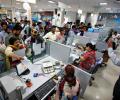
Public sector banks (PSBs) posted 16.1 per cent year-on-year (Y-o-Y) growth in net profit at Rs 39,974 crore during the June 2024 quarter. While net interest income (NII) showed subdued growth of 7.1 per cent, provisions and contingencies declined by 10.5 per cent Y-o-Y. This aided the bottom line to show steady growth.

The ongoing conflict between Ukraine and Russia is unlikely to have any major impact on the Indian rupee and the forex volatility in the country (USD/INR) has been much less now as compared to the global financial crisis which took place in 2008, SBI said in its Ecowrap research report. The report said that though the conflict between the two CIS nations may drag on for now, it is expected that the USD/INR, the most tracked pair in the local forex market, will trade at an elevated zone. But ideally, the expected average range of the rupee is expected to be in the band Between Rs 76 to Rs 78 to the USD with an appreciated bias.

From the Sensex pack, Tata Motors slumped over 7 per cent. Adani Ports, Tata Steel, SBI, Power Grid, JSW Steel and Maruti were the other big laggards. However, Hindustan Unilever and Nestle ended in positive territory.
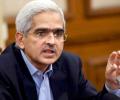
The December meeting of the Reserve Bank of India's (RBI's) six-member Monetary Policy Committee (MPC) will start on Wednesday even as there is no clarity on whether Governor Shaktikanta Das, the chair of the panel, will continue in office after his term ends next week. The outcome of the meeting will be announced on Friday by Das at 10 in the morning.
President Droupadi Murmu on Saturday approved 139 Padma awards including seven Padma Vibhushans, 19 Padma Bhushans and 113 Padma Shris.

Inflation, as measured on the Wholesale Price Index (WPI), has been in the negative zone since November 2014.

M&M was the biggest gainer in the Sensex chart, rising 6.51 per cent, followed by NTPC, PowerGrid, SBI, HDFC Bank, Asian Paints and Wipro. In contrast, Axis Bank, ITC, HUL, Nestle India and Sun Pharma were among the laggards.

In the Sensex pack, 20 stocks ended in the red while 37 of the Nifty constituents closed the session with losses. NTPC was the biggest loser among the Sensex constituents, ending with a loss of 2.71 per cent.

In May, MFs were the net sellers in several PSUs, as they deployed Rs 47,600 crore in equities during the month.

It also asked why the data shared pertained to a period from April 2019 even though the scheme for anonymous political funding was introduced in 2017.

Firms in which IP is critical, such as pharma and research and knowledge-based organisations, were taking the lead in seeking cyber covers to protect their computer systems from hack attacks

'Those betting against PSUs will likely be punished in this upswing.'
Benchmark equity indices Sensex and Nifty rebounded on Wednesday, propelled by bargain hunting in index majors Reliance Industries, ITC and SBI amid a largely firm trend in global equities. In a highly volatile trade, the 30-share BSE Sensex rebounded 89.64 points or 0.12 per cent to settle at 72,101.69. During the day, it jumped 390.62 points or 0.54 per cent to 72,402.67.

Say their aggregate borrowings were "well within the norms"

The report said that "we believe, institutions are more important than individuals" and ultimately what is important is the credibility and the independence of any institution and nothing else.

An index value of 42 to 46 means moderate decline.

Midcap stocks Hero MotoCorp, Zydus Lifesciences, JSW Energy, NHPC, Bharat Heavy Electricals, Bosch, and Samvardhana Motherson are expected to earn upgrades.

The report, however, admitted that 10 of these top 15 districts are major cities and among them Bengaluru and Pune still have higher infection rates.

To minimise risk, invest in a debt fund whose duration matches your investment timeframe.

Trading in stock markets this week will be majorly influenced by the upcoming quarterly earnings from IT majors TCS and Infosys, along with global trends, analysts said. Besides, global oil benchmark Brent crude, rupee-dollar trend and trading activity of foreign investors would also dictate the movement, they said. "On the domestic front, all eyes will be on the beginning of corporate performance for the third quarter of the current fiscal year.

Among the Sensex firms, State Bank of India rose the most by 3.78 per cent after the bank announced the acquisition of SBI CAPS subsidiary for Rs 708.07 crore. Nestle India gained 1.68 per cent after it reported around 9 per cent growth in sales. JSW Steel, Bajaj Finance, Axis Bank and Asian Paints were among the gainers.

Among the Sensex constituents, 18 stocks closed in negative with UltraTech Cement, L&T, Bharti Airtel, Bajaj Finance and Tech Mahindra being major laggards. Other heavyweights like Asian Paints, Maruti, Titan and JSW Steel also saw heavy selling. In contrast, Kotak Mahindra Bank, Bajaj Finserve, HDFC Bank, ITC and SBI bucked the trend and ended the session with a gain of up to 2.09 per cent.

Among the Sensex constituents, 20 stocks ended the session in green with HDFC Bank, Titan, Tech Mahindra, and Asian Paints being the major gainers. TCS, Maruti, Kotak Mahindra Bank and Bajaj Finserve were the other gainers. In contrast, SBI, Bharti Airtel, JSW Steel, PowerGrid, ITC and Reliance closed the trading with losses.

Operating margins have been the primary driver of corporate earnings in India in recent quarters, despite revenue growth suffering from weak consumer demand. Companies across sectors have reported a sharp improvement in earnings before interest, tax, depreciation, and amortisation (Ebitda) margins over the past two years, benefiting from lower commodity and energy prices. Higher margins more than compensated for slower revenue growth, resulting in double-digit growth in net profit for five consecutive quarters.
